The Evidence Engine
What it is
The part that does the work. It finds what AI search is missing about you, writes the missing piece, publishes it, and then checks on a later run whether it made any difference. On Growth and above it runs on a schedule — every 6 hours on Growth, 4 on Agency, 3 on Enterprise — so you don't have to press anything. On Starter it runs when you press "Run now"; that is the difference the plan buys, and we say so rather than implying a cadence you don't have.
Why it matters
When somebody asks an AI "who's the best roofer in Bath", the AI doesn't make the answer up from nothing. It answers from what it can find written down. So if there's nothing written down that shows you fix roofs in Bath — no clear explanation, no examples of jobs you've done, no answers to the questions people actually ask — the AI can't name you. It doesn't matter how good you are at the job. There's nothing to point at. A missing piece like that is what we call an evidence gap. The engine finds them and fills them in.
How the loop works
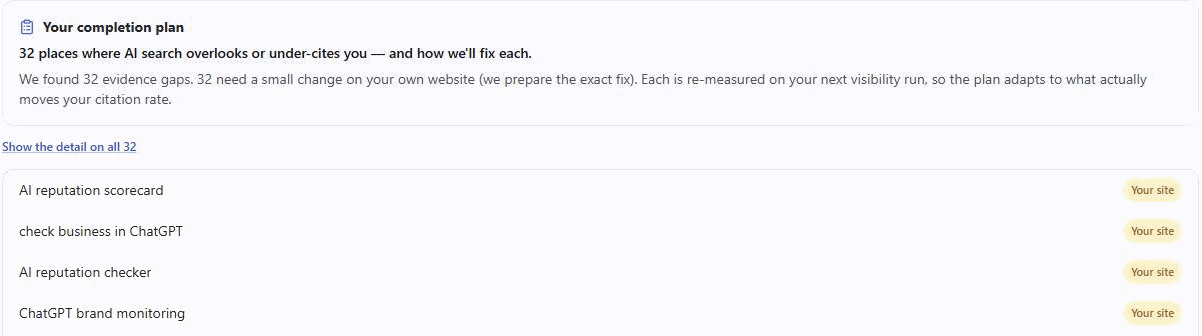
1. FIND — it asks AI engines the questions your customers ask, sees where you're absent, and reads your own site so it only flags things you genuinely don't have. 2. DECIDE THE SHAPE — before a word is written, two or three of your own AI providers say what kind of page the topic needs and which things it must contain. Once per topic, on your credit. A topic that names one of your own products which nothing on your site explains is not written at all: the project page asks you what it is — a line, a link to the page or video that shows it — and waits. 3. BUILD — it writes the missing piece from your own pages and videos on the subject, your line, and sources it has read. Anything it cannot support is cut before publishing, and a thin subject gets a shorter page. Where you have said what something is, your line holds for every section, not only the opening, and a source that uses the same words for something else is not used for it. Each writer is told to make every section name its own subject, so a passage an AI quotes on its own still makes sense; if you switched on the passage check, a section that still does not stand alone is flagged in the gap's notes, never rewritten. 4. PUBLISH — to your own site where you've connected one, and to your Google properties. If you switched on Review before publishing, the page waits for you under Needs you until you press Close it now. A Doc, Sheet or deck that arrives after its page is added to that page and the page updated in place — never over edits or additions you made on your site, and with Review before publishing on, only once you approve it on the project page. On a page an AI engine is citing, that update always waits for your approval, whatever the setting: we never rewrite the text of a cited page until you have approved the change. Google Docs, Sheets and Slides can be held for your review too, per project, and they go out at most one batch a day per campaign — see Reviewing before anything goes out. And it never publishes a second piece on the same subject to the same place within 30 days (Settings → One piece per subject, per place, between 7 and 365): no second guide in Google Docs, no second page on your site, no second post on your Blogger blog. An FAQ beside a guide, or the page on your own site that follows a Google Doc, still goes out. A gap whose campaign already has the piece it asks for is closed on that piece; any other gap it would repeat is set aside with the reason and when it could be made again. The classic recipes' own generators are not affected; a topic cluster's pieces are, in any campaign. 5. RE-MEASURE — later visibility runs ask the same questions again and record what changed. Publishing is not the result; a later run is, and it can take weeks to show anything. A gap found by the scan has no before of its own unless you switched on before-readings; with them, its note gives the before and the after, each with the number of answers it rests on. Each gap whose evidence was published shows "Cited in X of N runs checked since publishing", with the engines, on the project page. N is every completed run since publishing — at most the 30 most recent, and it says so — not only the runs that asked that gap's question. Evidence you held or withdrew never counts, AI Overview readings are not included, and a gap no run has checked since says so ("Published; no visibility run on this project has checked since.") rather than showing 0. It is an association, not proof that the evidence caused the citation. That last step is a measurement, not a verification. Whether an engine picks a page up depends on retrieval and popularity nobody controls, so a zero there is reported as a zero and never attributed to anything.
Which campaign a gap goes to
Each gap goes to the campaign on your site whose keywords or target page cover it, and its evidence is published under that campaign. A campaign that should do only its own work - a one-off, or a test - can be kept out: switch on "Keep the Evidence Engine's gaps out of this campaign" in its SmartStack settings. The engine then gives it no gaps and stops looking for new ones under it. Its open gaps move to another campaign on the site that covers them, and any that none covers are left unassigned. A gap left unassigned is not stuck. That happens when several campaigns share a site and a gap's topic is in none of their keywords or target pages, or when no campaign there takes the engine's work. Every run of the engine looks at those gaps again and gives each one to the campaign on its site whose keywords or target page now name its topic. So to route one, give the campaign that should own it a keyword or target page that names the topic, and the next run moves it there. The engine never picks between campaigns the topic does not tell apart, never gives work to a campaign that is kept out, and never makes a campaign of its own on a site you have one for. Until a gap moves, its card in the Evidence Engine says what would move it.
It paces itself over days rather than dumping everything at once — a hundred pages appearing overnight looks exactly like spam, to Google and to a reader.
Gap found: nobody has written anything comparing your service to the obvious alternative → engine writes an honest comparison → publishes it → two weeks later the same question names you